📄 Download Full Whitepaper (PDF)
Abstract
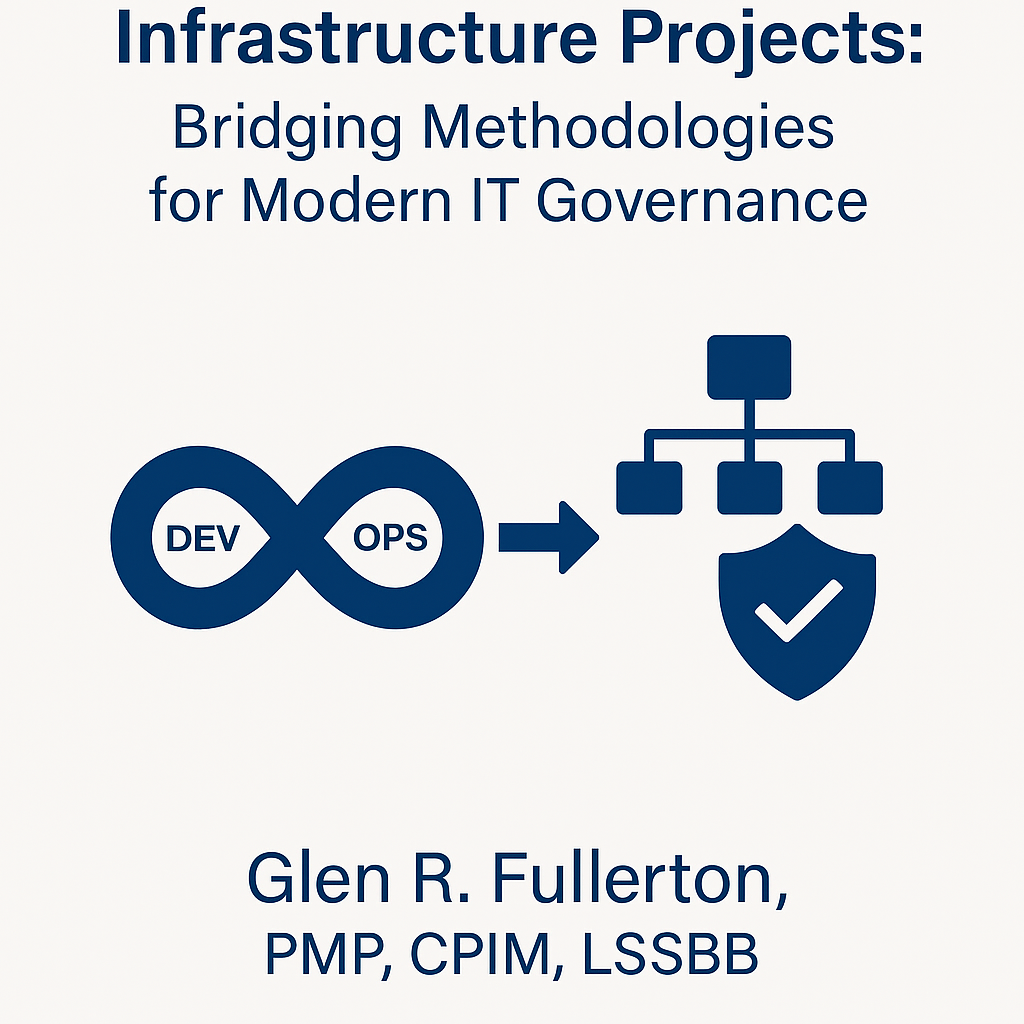
This whitepaper explores the integration of DevOps principles into IT infrastructure projects, analyzing benefits, limitations, and governance frameworks that bridge traditional project management and modern DevOps practices. It provides a structured roadmap for organizations seeking to balance speed and innovation with control, compliance, and predictability, emphasizing the importance of unified governance rather than uniform methodology.
Executive Summary
DevOps has transformed software delivery by enabling rapid, iterative releases and collaboration between development and operations. However, infrastructure projects—characterized by physical dependencies, capital investments, and regulatory compliance—require different approaches.
This paper provides a framework for combining DevOps and traditional project management methodologies to create cohesive governance across IT portfolios.
Key recommendations include establishing project classification criteria, implementing adaptive PMO structures, defining unified governance standards, and investing in cross-methodology training.
1. Introduction
The increasing adoption of DevOps practices has yielded remarkable improvements in software development cycles, reducing deployment times and enhancing quality. Yet, organizations striving for enterprise-wide consistency in project management often find that DevOps principles do not directly translate to infrastructure projects.
This paper examines these challenges and proposes a hybrid governance model to integrate DevOps where it adds value while preserving the structure required for complex infrastructure initiatives.
2. Understanding DevOps and Its Core Principles
DevOps represents a cultural and technical movement uniting development and operations to improve software delivery. Its key principles—automation, continuous integration and delivery (CI/CD), infrastructure as code (IaC), and collaborative culture—drive iterative improvement and speed to market.
These strengths, however, are best realized in software-defined contexts rather than hardware-bound infrastructure environments.
3. The Infrastructure Project Challenge
Infrastructure projects differ from SDLC initiatives in lifecycle structure, risk tolerance, and dependency on physical assets.
They typically feature defined start and end points, capital expenditure, regulatory oversight, and limited ability to iterate once deployed.
These realities conflict with DevOps assumptions of continuous delivery, flexible timelines, and minimal documentation.
Table 1 – Benefits and Challenges of Applying DevOps to Infrastructure
| Benefits | Challenges |
|---|---|
| Automation reduces human error and accelerates deployment | Physical work cannot be automated or version-controlled |
| IaC enhances consistency and repeatability | Hardware and facilities lack rollback capability |
| Collaboration improves cross-team communication | Compliance and approval processes slow iteration |
| Monitoring increases visibility and performance tracking | Tooling mismatches limit integration across teams |
4. Recommendations for Unified IT Governance
To harmonize methodologies, organizations should adopt a classification framework distinguishing between DevOps-native, hybrid, and traditional infrastructure projects.
A flexible PMO structure ensures that governance, risk management, and financial controls are consistent, while delivery approaches vary by project type.
Key recommendations include:
- Define project classification criteria.
- Establish universal governance standards for risk, compliance, and financial management.
- Implement adaptive PMO structures.
- Invest in cross-disciplinary training for both DevOps and infrastructure professionals.
5. Future Outlook
The evolution of DevOps continues toward Site Reliability Engineering (SRE), Platform Engineering, and AIOps.
These practices bridge development and infrastructure by emphasizing automation, observability, and resilience.
As organizations mature, these disciplines will redefine IT governance—balancing autonomy and accountability through data-driven performance and predictive analytics.
6. Conclusion
DevOps provides powerful mechanisms for agility and innovation but is not universally applicable to all IT projects.
By creating unified governance frameworks that integrate DevOps with traditional methodologies, organizations can achieve consistency in outcomes without constraining flexibility.
The objective is not to standardize methodology but to ensure governance coherence across diverse project types.
Unified governance, not uniform methodology — that is the hallmark of a mature IT organization.
References
- Kim, G., Humble, J., DeBois, P., & Willis, J. (2016). The DevOps Handbook. IT Revolution.
- Forsgren, N., Humble, J., & Kim, G. (2018). Accelerate: The Science of Lean Software and DevOps. IT Revolution.
- Skelton, M., & Pais, M. (2019). Team Topologies. IT Revolution.
- Google. (2016). Site Reliability Engineering: How Google Runs Production Systems. O’Reilly Media.
- Project Management Institute. (2017). Agile Practice Guide. Project Management Institute.
- AXELOS. (2019). ITIL 4 Foundation Edition. The Stationery Office.